Plant Growth Regulators in Plant Tissue Culture: A Complete Guide
Plant Growth Regulators (PGRs), also known as plant hormones, are one of the most important components of any successful plant tissue culture medium. Whether you're propagating orchids, houseplants, carnivorous plants or rare species, selecting the correct Plant Growth Regulators can mean the difference between vigorous growth and complete culture failure.
Unlike plants growing naturally, tissue cultures rely almost entirely on the culture medium to provide the chemical signals needed for growth and development. By adjusting the type and concentration of Plant Growth Regulators, it is possible to encourage root formation, stimulate shoot multiplication, promote embryo development or even maintain dormant cultures.
This guide explains how Plant Growth Regulators work, the different types available and how they are used throughout the micropropagation process.
What Are Plant Growth Regulators (PGRs)?
Plant Growth Regulators are naturally occurring or synthetic compounds that influence plant growth and development at extremely low concentrations. They regulate processes including:
- Cell division
- Cell elongation
- Root initiation
- Shoot formation
- Flowering
- Seed germination
- Dormancy
- Stress responses
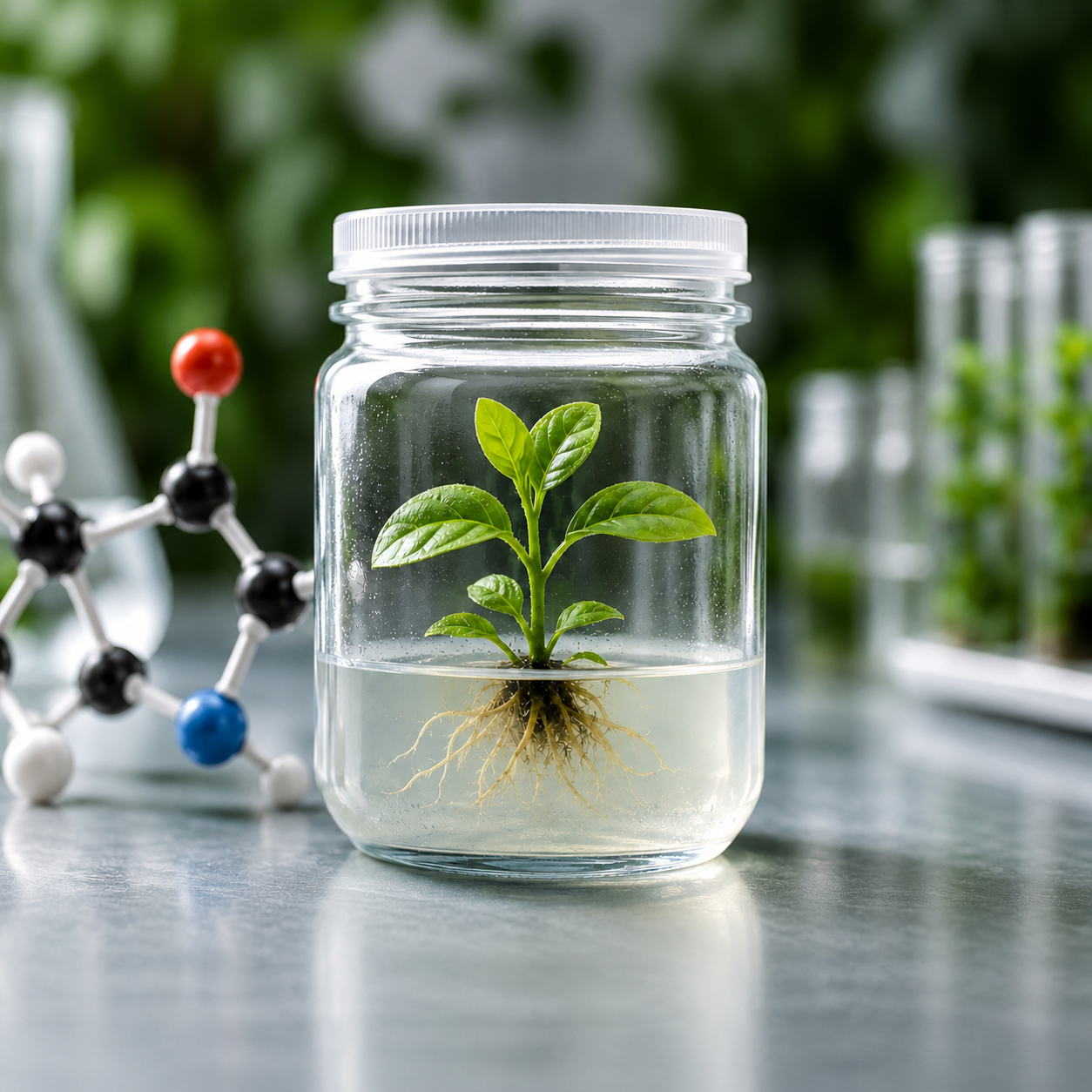
In plant tissue culture, these compounds are added directly to the culture medium, allowing precise control over plant development in vitro.
Why Plant Growth Regulators Are Essential in Plant Tissue Culture
Plant tissue culture depends on carefully controlled conditions. Although nutrients, sugars and vitamins provide the resources for growth, Plant Growth Regulators tell the plant cells what to do.
Without the correct PGR balance, cultures may:
- Fail to produce shoots
- Produce excessive callus
- Develop weak or abnormal growth
- Fail to root
- Become dormant
By manipulating Plant Growth Regulators, growers can direct the developmental pathway of cultured tissues.
How Plant Growth Regulators Work Inside Plant Cells
Plant cells constantly communicate through chemical signalling pathways. Plant Growth Regulators bind to specialised receptors within cells, triggering changes in gene expression that determine how cells divide and develop.
Depending on the combination of hormones present, identical cells may become:
- Roots
- Shoots
- Callus tissue
- Somatic embryos
- Leaves
This remarkable flexibility is known as totipotency, one of the defining characteristics of plant tissue culture.
The Five Main Classes of Plant Growth Regulators
Five primary groups of Plant Growth Regulators are commonly recognised:
- Auxins
- Cytokinins
- Gibberellins
- Abscisic Acid (ABA)
- Ethylene
Each group performs different functions, although their effects often overlap and interact.
Auxins: Functions, Uses and Common Types
Auxins promote cell elongation and are primarily responsible for root development.
In tissue culture they are commonly used for:
- Root induction
- Callus formation
- Somatic embryogenesis
- Cell expansion
Common auxins include:
- Indole-3-acetic acid (IAA)
- Indole-3-butyric acid (IBA)
- 1-Naphthaleneacetic acid (NAA)
- 2,4-Dichlorophenoxyacetic acid (2,4-D)
Among these, 2,4-D is widely used to induce callus formation, while IBA and NAA are popular choices for rooting.
Cytokinins: Promoting Shoot Growth and Cell Division
Cytokinins stimulate cell division and encourage shoot production.
They are essential during the multiplication stage of micropropagation because they increase the number of shoots produced from each explant.
Common cytokinins include:
- 6-Benzylaminopurine (BAP or BA)
- Kinetin
- Zeatin
- Thidiazuron (TDZ)
Higher cytokinin levels generally encourage shoot proliferation while suppressing root formation.
Gibberellins: Encouraging Stem Elongation and Germination
Gibberellins are less frequently used in tissue culture but can be valuable for specific applications.
Typical uses include:
- Breaking seed dormancy
- Encouraging stem elongation
- Promoting embryo development
- Improving germination of difficult species
The most commonly used gibberellin is GA₃ (Gibberellic Acid).
Abscisic Acid (ABA): The Plant Stress Hormone
Abscisic Acid is often associated with stress responses and dormancy.
In tissue culture it may be used to:
- Improve embryo maturation
- Reduce unwanted growth
- Increase stress tolerance
- Encourage storage organ formation
ABA is particularly useful during somatic embryogenesis.
Ethylene: Its Role in Plant Growth and Development
Ethylene is a gaseous Plant Growth Regulator produced naturally by plant tissues.
Inside sealed culture vessels, ethylene can accumulate and influence growth by:
- Accelerating ageing
- Causing leaf yellowing
- Reducing shoot quality
- Altering root development
Good vessel design and adequate gas exchange help minimise unwanted ethylene accumulation.
Natural vs Synthetic Plant Growth Regulators
Some Plant Growth Regulators occur naturally in plants, while others are synthetic compounds developed for laboratory use.
Natural hormones include:
- IAA
- Zeatin
- ABA
- Ethylene
Synthetic alternatives such as BAP, NAA and 2,4-D are often preferred because they are:
- More stable
- Longer lasting
- Easier to prepare
- More consistent in tissue culture applications
The Most Common Plant Growth Regulators Used in Micropropagation
Most hobbyists and commercial laboratories regularly use:
- BAP (BA)
- TDZ
- Kinetin
- IAA
- IBA
- NAA
- 2,4-D
- GA₃
These Plant Growth Regulators cover the majority of propagation protocols used for ornamental, fruit and medicinal plants.
How Auxin-to-Cytokinin Ratios Affect Plant Development
Perhaps the most important principle in tissue culture is the balance between auxins and cytokinins.
As a general guide:
- High auxin + low cytokinin = root formation
- High cytokinin + low auxin = shoot formation
- Balanced concentrations = callus growth
Small changes in hormone ratios can dramatically alter plant development, making optimisation an important part of protocol development.
Choosing the Right Plant Growth Regulator for Your Culture Stage
Different stages of micropropagation require different Plant Growth Regulators.
Culture initiation
Low hormone concentrations help establish healthy explants.
Shoot multiplication
Higher cytokinin concentrations encourage rapid shoot production.
Rooting
Auxins are increased to promote healthy root systems.
Acclimatisation
Plants are usually transferred to hormone-free conditions before moving to soil.
How to Prepare and Store Plant Growth Regulator Stock Solutions
Because Plant Growth Regulators are active at extremely low concentrations, stock solutions are commonly prepared.
Good laboratory practice includes:
- Using analytical balances
- Preparing concentrated stock solutions
- Labelling clearly
- Storing under recommended conditions
- Protecting light-sensitive hormones from exposure
- Freezing long-term stocks where appropriate
Always check the recommended solvent, as some PGRs dissolve readily in water while others require small amounts of sodium hydroxide, hydrochloric acid or ethanol before dilution.
Typical Plant Growth Regulator Concentrations in Tissue Culture Media
Most Plant Growth Regulators are used between **0.1 and 5.0 mg/L**, although optimal concentrations vary greatly between species.
Examples include:
- Shoot multiplication: 0.5–2.5 mg/L BAP
- Root induction: 0.1–2.0 mg/L IBA or NAA
- Callus induction: 1–3 mg/L 2,4-D
Every species responds differently, so published protocols provide an excellent starting point before optimisation.
Common Mistakes When Using Plant Growth Regulators
Many beginners experience problems because of incorrect hormone use.
Common mistakes include:
- Using excessively high concentrations
- Incorrect hormone ratios
- Poor stock solution preparation
- Using degraded or expired hormones
- Measuring inaccurately
- Following protocols designed for different plant species
Careful record-keeping makes troubleshooting much easier.
Troubleshooting Poor Growth Caused by Incorrect PGR Levels
If cultures are not developing as expected, review the Plant Growth Regulators first.
Typical symptoms include:
- No shoot production
- Excessive callus formation
- Hyperhydric (glassy) shoots
- Weak roots
- Stunted growth
- Tissue browning
Making small, controlled adjustments to hormone concentrations often produces significant improvements.
Frequently Asked Questions About Plant Growth Regulators
Are Plant Growth Regulators the same as plant hormones?
Yes. The terms are often used interchangeably, although Plant Growth Regulator also includes synthetic compounds that mimic natural hormones.
Can I perform plant tissue culture without Plant Growth Regulators?
Some species can grow on hormone-free media, particularly during seed germination, but most micropropagation protocols require one or more Plant Growth Regulators.
Which Plant Growth Regulator is best for rooting?
IBA and NAA are among the most commonly used auxins for root induction.
Why do different plants require different PGR concentrations?
Each species has its own sensitivity to hormones, so protocols must often be adjusted through experimentation.
Plant Growth Regulator Safety, Handling and Storage Tips
Although Plant Growth Regulators are used in very small quantities, they should always be handled responsibly.
Best practices include:
- Wearing appropriate personal protective equipment.
- Avoiding inhalation of powders.
- Preparing solutions in a clean workspace.
- Clearly labelling all stock solutions.
- Following manufacturer storage recommendations.
- Disposing of unused chemicals according to local regulations.
Maintaining good laboratory practices helps ensure consistent experimental results while reducing the risk of contamination or accidental exposure.
Summary: Selecting the Right Plant Growth Regulators for Successful Micropropagation
Plant Growth Regulators are at the heart of successful plant tissue culture. By understanding how auxins, cytokinins, gibberellins, abscisic acid and ethylene influence plant development, you can tailor culture media to achieve reliable rooting, vigorous shoot multiplication and healthy plant growth.
For home tissue culture enthusiasts, learning to balance Plant Growth Regulators is one of the most rewarding skills to develop. Careful experimentation, accurate record-keeping and a willingness to refine your media formulations will help you achieve better results with a wide range of plant species. Whether you are propagating rare ornamentals or building your own DIY micropropagation laboratory, mastering PGRs will significantly improve your success rate and deepen your understanding of plant development in vitro.
Complete Guide to Micropropagation and Plant Tissue Culture in the UK

Benefits of Reverse Osmosis Water for Plant Tissue Culture